Ingrown Toenail Care in Jongno & Myeongdong Ingrown toenail care, without guesswork.
Ingrown toenail care at Obliv Seoul Origin in Jongno, central Seoul, starts with a physician assessing the nail edge and any infection. Mild cases are relieved by carefully trimming the offending edge; recurring or more severe cases may need partial nail removal under local anaesthetic when the physician considers it appropriate.

Ingrown Toenail Care, in brief.
The essentials, answered plainly. Your physician confirms what applies to your skin at consultation.
Ask a physician- What it is
- A toenail edge, usually on the big toe, pressing into or growing into the skin beside it, causing pain and sometimes infection.
- Common causes
- Cutting nails too short or curved at the corners, tight shoes, toe injury and naturally curved nails.
- How we assess it
- A physician checks how deep the edge sits, whether there is infection and whether it has happened before.
- Mild cases
- Careful trimming of the nail spike and edge to take pressure off the skin, with advice on cutting and footwear.
- Severe or recurring cases
- Partial removal of the affected nail edge under local anaesthetic, when the physician considers it appropriate.
- Downtime
- Little after edge care; after partial nail removal, tenderness typically for a few days and dressings for 1–2 weeks.
- Infection
- Treated if your physician considers it necessary; spreading redness or fever needs prompt medical care.
- Results
- Usually quick relief; ingrown nails can recur, especially if the nail shape or cutting habits stay the same.
Why do toenails become ingrown?
Most ingrown toenails start with the corner of the nail cut too short or rounded, leaving a small spike that grows into the skin. Tight or pointed shoes squeeze the toe and push the skin over the nail edge, and a stubbed toe can do the same.
Some people simply have nails that curve more steeply at the sides, which makes recurrence more likely. A long day walking in Seoul in new shoes is a common trigger for a flare.
How is an ingrown toenail treated?
Treatment depends on the stage. If the toe is sore but not badly infected, your physician can often relieve it by carefully trimming the offending spike and edge so it no longer presses into the skin.
If the nail edge is deeply embedded, infected or keeps coming back, partial nail removal may be recommended. The toe is numbed with local anaesthetic and a narrow strip of nail along the affected side is removed; the rest of the nail is left in place. Your physician will explain whether this is appropriate for you and what recovery involves.
- Examination of the nail edge and surrounding skin
- Careful trimming of the nail spike
- Partial nail removal under local anaesthetic if needed
- Dressing and wound-care instructions
- Treatment of infection if your physician considers it necessary
- Advice on nail cutting and footwear
Recovery and timing around a trip
After edge trimming, most people walk comfortably the same day. After partial nail removal, expect tenderness for a few days and a dressing that needs changing; the area usually settles over 1–2 weeks. Open or roomy shoes help.
If you are visiting Seoul, it is kinder to have a procedure early in your stay rather than just before a long-haul flight or a heavy walking day. Keep the foot raised when you can and follow the dressing instructions you are given.
When should an ingrown toenail be seen urgently?
Redness spreading up the toe or foot, pus, swelling, red streaks or fever suggest infection that needs prompt medical care, not just a nail trim.
If you have diabetes, poor circulation, numbness in your feet, spreading redness, fever or a wound that is not healing, please seek prompt medical care — and tell us when you book, so your physician can decide whether the clinic is the right place or whether you should be seen urgently elsewhere.
Edge trimming vs partial nail removal
| Edge trimming | Partial nail removal | |
|---|---|---|
| Suits | Mild, early ingrown edge | Embedded, infected or recurring edge |
| Anaesthetic | Usually not needed | Local anaesthetic to numb the toe |
| What is removed | The small nail spike and sharp edge | A narrow strip of nail along one side |
| Afterwards | Walk normally the same day | Tender for a few days; dressings for 1–2 weeks |
| Recurrence | More likely if nail shape persists | Less likely, though still possible |
When people book ingrown toenail care
From first message to follow-up.
Consultation, plan and aftercare are handled in English — whether you live in Seoul or are here for a few days.
Message us on WhatsApp with your concerns and travel dates. We reply with availability.
A physician examines the skin and nails and asks about footwear, health and travel plans.
A clear plan and pricing before anything begins — often on the same day when appropriate.
Written aftercare, and your records kept in our Skin Library for your next visit.
Not sure it is right for you?
Send a photo and a few lines about your foot concern. The team will tell you whether it is something we can help with — or where you should be seen instead.
Start a WhatsApp enquiry
Ingrown Toenail Care — asked & answered.
General information only. Your physician will advise on what is right for your skin.
Ask your own questionDo I need the nail removed?
Not always. Many mild cases are relieved by trimming the offending edge; partial removal is considered when the edge is deeply embedded, infected or recurring.
Is partial nail removal painful?
The toe is numbed with local anaesthetic, so the procedure itself should not be painful beyond the injection. Expect tenderness for a few days afterwards.
Can I fly after ingrown toenail treatment?
Usually, yes, but after partial nail removal it is more comfortable to allow a few days before a long flight. Wear loose shoes and keep the foot raised where you can.
Do I need antibiotics?
Only if your physician considers it necessary. Many ingrown nails improve once the edge is relieved; spreading redness or fever needs prompt medical care.
How can I stop it happening again?
Cut nails straight across and not too short, and wear shoes with enough toe room. If it keeps recurring, ask your physician about longer-term options.
Can I walk in with a painful toe?
Sometimes, depending on availability and physician assessment. Messaging us on WhatsApp first is the most reliable way to be seen promptly.
Related reading.
Thick Toenail Care
Thick or discoloured toenails thinned for comfort; fungal causes treated or referred.
Read more → Skin of the feetMedical Foot Care
Physician-led care for calluses, corns, cracked heels and troublesome toenails.
Read more → Skin of the feetCorn Removal
Small, sharply painful corns carefully pared and the core removed, with off-loading advice.
Read more → ToenailsEnglish-Speaking Foot Clinic
Foot and toenail care with English consultations and WhatsApp booking, in central Jongno.
Read more → Visiting usWalk-In Skin Clinic
Walk in to ask, or message ahead — how unbooked visits work at our Jongno clinic.
Read more →Visit the maison.
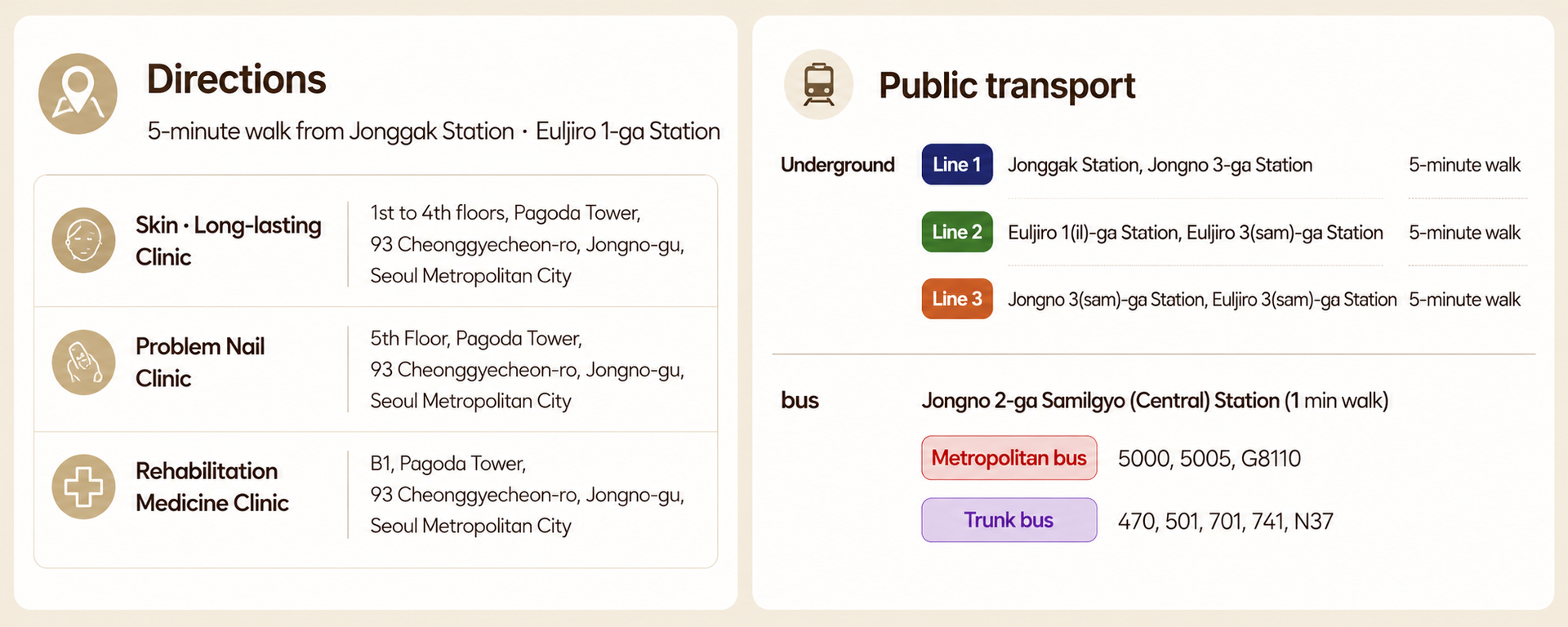
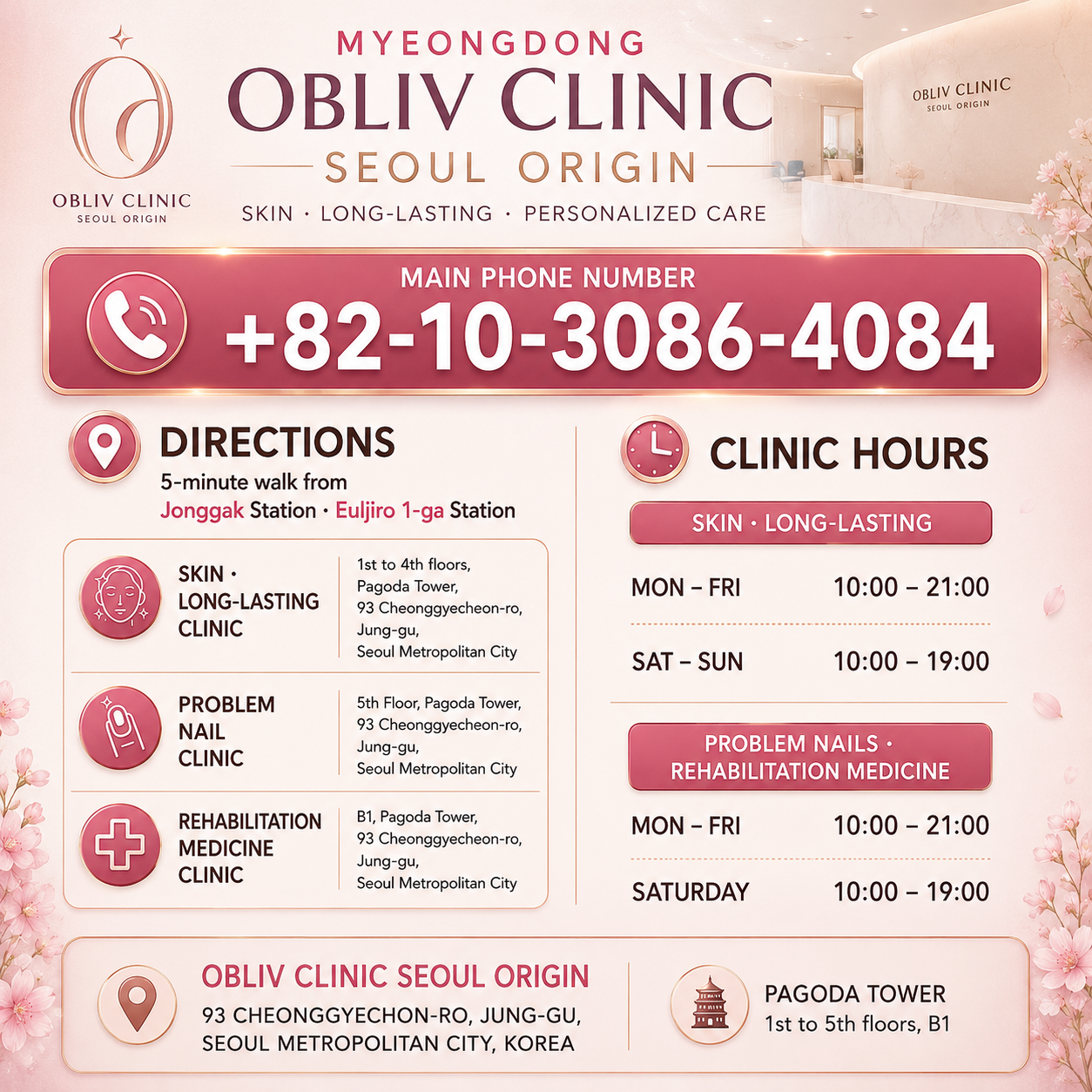
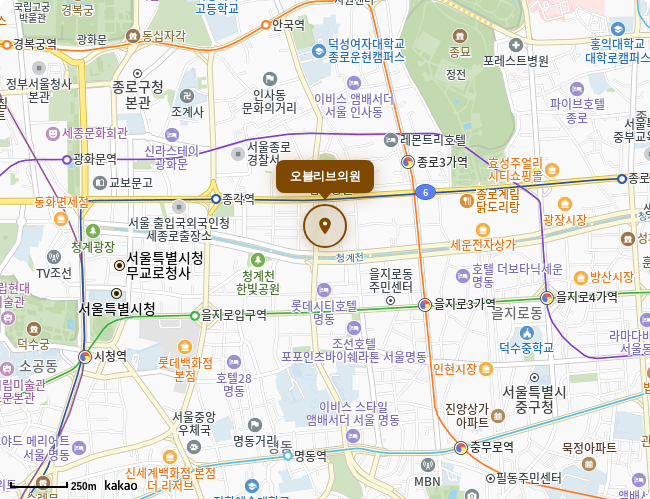
Pagoda Tower, 1st–2nd floor
93 Cheonggyecheon-ro, Jongno-gu, Seoul
서울특별시 종로구 청계천로 93 파고다타워 1~2층
Line 2 — Euljiro 1-ga, Euljiro 3-ga
Line 3 — Jongno 3-ga, Euljiro 3-ga
Medical information on this page is for general education and does not replace an in-person consultation. Results, downtime and suitability vary between individuals; all treatments are performed only after physician assessment. Page reviewed by the Obliv Seoul Origin medical team.